 |
 |
 |

 |
|
|

| Government advice on sensible drinking for adults | |
Women: maximum of 2 drinks per day and a maximum of 10 drinks per week  |
Men: A maximum of 3 drinks per day and a maximum of 15 drinks per week
|

UNITS AND GUIDELINES
Canadian responsible drinking guidelines
How alcohol effects us depends on many factors such as your age, size, sex and health. How quickly you drink, and whether it is with food or on an empty stomach, also effects how quickly you absorb alcohol.
 |
The Government looks at the risks and benefits of drinking alcohol and has been able to draw up guidelines for safe or low risk drinking. These are for healthy adults. Canada has one national set of low-risk alcohol drinking guidelines, which are supported by federal, provincial and territorial health ministers, as well as many respected Canadian organizations.
Women are advised not to drink more than two drinks a day and up to a maximum of 10 drinks a week and men no more than three drinks a day, up to a maximum of 15 drinks a week. The advice suggests planning non-drinking days every week to avoid developing a habit.
| A drink is defined as: |
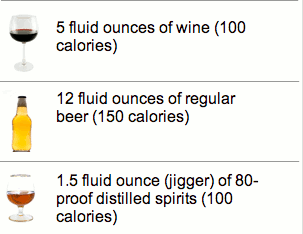 |
|
The Drink Dashboard is an online tool to help people monitor and understand their drinking. It also provides other helpful information, including the impact of alcohol on health, the definition of a drink, calorie contents, and calorie equivalents in terms of common foods and physical activity. |


These guidelines are intended for Canadians of legal drinking age who choose to drink alcohol and are informed by the most recent and best available scientific research and evidence. They are intended to provide consistent information across the country to help Canadians moderate their alcohol consumption and reduce their immediate and long-term alcohol-related harm. ccsa.ca/canadas-low-risk-alcohol-drinking-guidelines-brochure
See also ccsa.ca/knowing-your-limits-alcohol-practical-guide-assessing-your-drinking
The guidelines recommend the following Safer drinking tips
- Set limits for yourself and stick to them.
- Drink slowly.
- Have no more than 2 drinks in any 3 hours.
- For every drink of alcohol, have one non-alcoholic drink.
- Eat before and while you are drinking.
- Always consider your age, body weight and health problems that might suggest lower limits.
- While drinking may provide health benefits for certain groups of people, do not start to drink or increase your drinking for health benefits
Your limits
- Reduce your long-term health risks by drinking no more than: 10 drinks a week for women, with no more than 2 drinks a day most days 15 drinks a week for men, with no more than 3 drinks a day most days
- Plan non-drinking days every week to avoid developing a habit.
- Special occasions: Reduce your risk of injury and harm by drinking no more than 3 drinks (for women) or 4 drinks (for men) on any single occasion.
- Plan to drink in a safe environment.
- Stay within the weekly limits outlined above in Your limits.
This level of intake appears to pose few health risks for most people and may be beneficial to health for some people, especially men over 40 and post menopausal women due to alcohol's cardiovascular protective effects. Generally, those adults who choose to drink should do so in a sensible manner as part of a healthy diet and lifestyle and preferably around mealtimes or with food. The consumption of small amounts of alcohol on a regular basis is more healthful than sporadic consumption of larger amounts of alcohol. Episodes of heavy intake (e.g. weekend bingeing alternating with weekday abstinence) is associated with health and safety risks. This pattern of drinking should not be regarded as moderate or healthful, even if the individual’s total weekly alcohol intake is within the limits of moderation.
Why are there different guidelines for men and women?
Women's bodies are generally smaller and have less body water, so alcohol concentrations rise more quickly. Sorry ladies, but you can’t drink as much as men. That’s not a male conspiracy theory but a biological fact! Women have less body water than men so the concentration of alcohol in their blood stream is proportionally higher. So, if a woman weighing 60 kgs drinks a double vodka then a man of the same size will need to drink a triple in order to reach the same blood alcohol level. There is also some evidence that women break down alcohol slightly differently. The enzyme ADH breaks down alcohol in the liver and in the lining of the stomach; and women have less of it, so alcohol is broken down more slowly.
When not to drink
Official drinking guidelines are issued by governments and public health to advise on levels of alcohol consumption considered 'safe', 'responsible,' or 'low risk'. They do not apply to those under the legal drinking age or to pregnant women. Those on medication or with a history of illness should consult their general practitioner or specific advice. For religious or health reasons nearly half of adults around the world choose not to drink (45%). Responsible drinking means drinking enjoyably, sociably and moderately and includes not drinking at all in situations when the effects of alcohol will put your own or someone's safety or health at risk
Do not drink when you are:
- driving a vehicle or using machinery and tools
- taking medicine or other drugs that interact with alcohol
- doing any kind of dangerous physical activity
- living with mental or physical health problems
- living with alcohol dependence
- pregnant.
How much do Canadians Drink?
Most Canadian adults drink alcoholic beverages, with beer the most popular choice. About 77% of Canadians drank alcohol in the last year. 13.5% are former drinkers and about 10% percent of Canadians abstain from drinking alcohol. However, just 26% of Canadians are aware of the low risk drinking guidelines,which might account for why 14.4% of the adult population exceed the low risk guidelines of 2 drinks a day for women and 3 for men, with 10% drinking more than 10 drinks a week for women and 15 drinks for men.
Potential Health Benefits of Moderate Alcohol Use
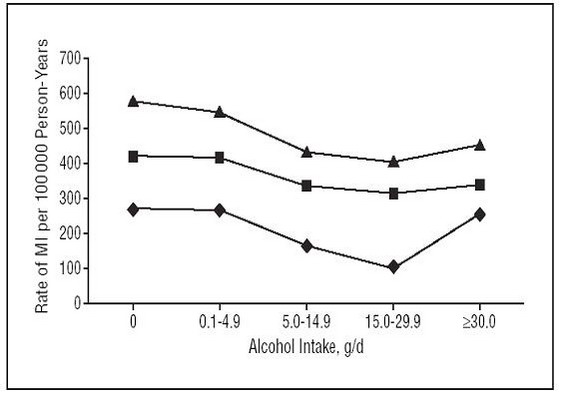 When most people talk about the benefits of alcoholic beverages, they're usually referring to the pleasant, relaxed feeling and enhanced sociability that often result from drinking. When scientists and health professionals talk about the benefits of alcohol use, however, they are primarily referring to the fact that moderate drinking may reduce the risk of certain diseases, especially coronary heart disease. Among middle-aged and elderly people, moderate drinkers have lower mortality rates than abstainers - this is known as the 'J' shaped curve, or French paradox. In simple terms, alcohol stimulates the liver to produce 'good' HDL cholesterol and 'thins' the blood, helping prevent the build up of harmful clots or 'hardening of the arteries. In contrast, among younger adults alcohol consumption appears to provide little, if any, health benefit, and excess alcohol consumption among young adults is associated with a higher risk of traumatic injury and death. Consumers should enjoy drinking in moderation as one element of the 'healthy lifestyle' choices of regular exercise, not smoking, staying slim and a diet rich in fruit and vegetables and low in saturated fat. If you can manage this and enjoy drinking in moderation, your risk of chronic diseases reduce by more than 50%.
Advice For Today
If you chose to drink alcoholic beverages, do so sensibly, and in moderation.
No one should drink alcohol, even in moderation, before operating a motor vehicle or engaging in other activities that involve attention and skill or physical risk. Such activities include operating machinery, boating, swimming, diving and skiing.
Some people need to abstain from or minimize their use of alcohol for health reasons. These people include:
- individuals with a personal or family history of alcohol abuse;
- persons who cannot keep their drinking moderate;
- women who are pregnant or who are planning to conceive;
- individuals who are taking prescriptions or over-the-counter medications that can interact adversely with alcohol or with other components of alcoholic beverages.
See Educ Alcool's publications on low risk drinking and the effects of moderate regular alcohol consumption in 'Further Sources' section below.
The bottom line message
Most people who drink do so moderately and responsibly as part of a healthy diet and lifestyle. Common sense tells us to drink responsibly at any time and especially if you are planning to drive or undertake other activities that require skills. Alcohol can be enjoyed as part of a healthy lifestyle in moderation, but it is not recommended that anyone begin drinking or drink more frequently on the basis of their health. Enjoyment of wine, beer and spirits has formed part of a pleasurable part of many traditions, cultures and some religions around the globe since civilization began.
Further sources of information
Information on sensible drinking guidelines worldwide
 |
 |
 |